
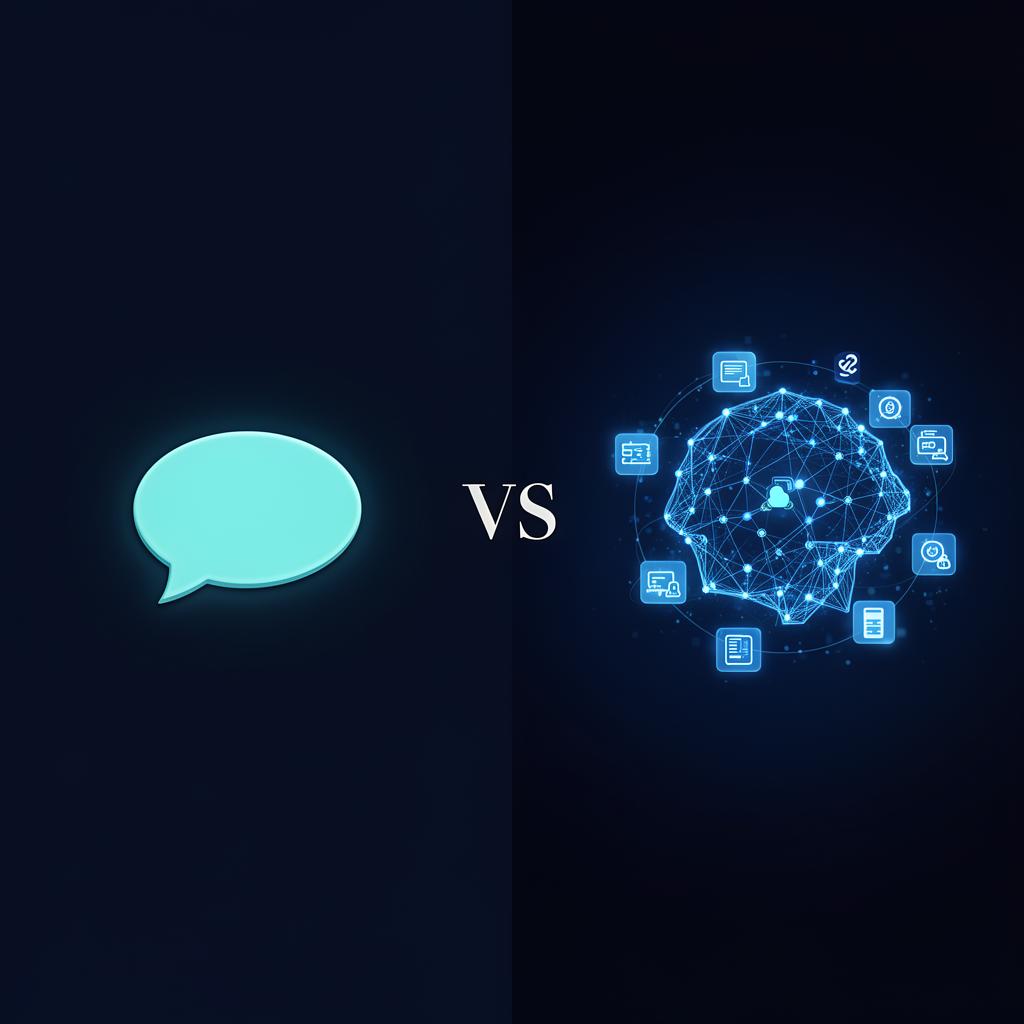
AI Agents vs Chatbots: What's Actually Different in 2026
Every vendor calls their product an "AI agent". Most are chatbots with better marketing. Here's how to tell them apart, and which one your business actually needs.
If you've sat through any vendor demo in the last twelve months, you've heard the word "agent" used to describe everything from a Slack bot to a fully autonomous sales rep. The label is doing a lot of heavy lifting, and most of the time it's covering for a product that hasn't actually changed. The distinction matters because the cost, complexity and capability gap between a real agent and a dressed-up chatbot is now an order of magnitude wide. Buying the wrong one for your use case is an expensive, very public mistake.
The one-sentence test
The cleanest way to draw the line is to look at what each one is designed to produce.
- A chatbot produces words inside a single conversation.
- An agent produces outcomes across multiple systems and steps.
A chatbot answers "when does my order arrive?". An agent reads the order, checks the carrier API, calculates a new ETA, refunds shipping if the package is late, updates the CRM, emails the customer, and logs the case - all without a human in the loop. Same input. Completely different output. Completely different infrastructure.
The architecture is fundamentally different
Real agents need infrastructure that chatbot platforms simply don't ship with. If a vendor can't explain how each of these works in their product, you're looking at a chatbot.
- Memory - short-term context plus long-term knowledge per user and account.
- Tool calling - typed, audited access to CRM, billing, calendar, search and internal APIs.
- Planning - the ability to decompose a goal into ordered, conditional steps.
- Guardrails - input validation, output checking and human-escalation paths.
- Observability - every step logged, replayable and measurable in production.
- Evaluation - automated regression tests on the agent's behaviour over time.
Building a production agent is closer to building a small autonomous service than configuring a chat widget. Off-the-shelf chatbot platforms can't get you there.
Where agents shine
Across our client base, four categories consistently produce the biggest ROI from agents - and the biggest leap over what chatbots can do.
- Outbound sales - qualifying inbound leads and booking discovery calls 24/7.
- Tier-1 customer support - resolving 40–70% of tickets end-to-end.
- Internal operations - HR, IT and finance back-office requests.
- Research-heavy knowledge work - competitive intel, deal prep, due diligence.
When a chatbot is still the right call
Don't reach for an agent just because it's fashionable. A well-designed chatbot still wins handily in several scenarios.
- FAQ deflection on a marketing site.
- Lead capture with light qualification.
- Simple guided flows (e.g. picking the right product tier).
- Internal knowledge lookup where no action is required afterwards.
How to choose in one question
Ask: does the value of this workflow come from the words exchanged, or from the action that follows? If it's words, you need a chatbot - and you should be ruthlessly cheap about it. If it's action, you need an agent, and you should budget seriously for design, evaluation, and observability.
Where to start
Pick one workflow where the action - not the conversation - creates the value. Map the systems it touches, the data it needs, and the failure modes you can't tolerate. That single page is enough to know whether you're scoping an agent or a chatbot. If you'd like an Orvanta engineer to sanity-check the scope, our 30-minute discovery call is free and refreshingly opinionated.
Frequently asked questions
What is the difference between an AI agent and a chatbot?
A chatbot produces words inside a single conversation. An AI agent produces outcomes across multiple systems and steps: it can read data, call tools, take actions, and complete a task end to end. If a product cannot plan, use tools, and act, it is a chatbot.
Do I need an AI agent or is a chatbot enough?
Ask where the value comes from. If it comes from the words exchanged, such as FAQ deflection or light lead capture, a chatbot is enough and you should keep it cheap. If it comes from the action that follows, such as resolving a ticket end to end, you need an agent.
Are AI agents more expensive than chatbots?
Yes. Expect several times the upfront engineering and higher running costs, because agents reason across multiple steps and systems. The return still works well when the automated work requires action, not just answers.
Related Orvanta services
Written by
Orvanta Team


